The KLX250/KLX300 has significant power potential with minimal investment in parts. Two things unlock it:
- Improve airflow through the intake, head, and exhaust by removing bottlenecks.
- Adjust fuel supply to match the increased airflow.
The first is hardware — see the Intake guide. The second is ECU tuning, which splits into fuel management (the common approach) and advanced tuning that alters ignition timing.
How the KLX meters fuel: the ECU reads RPM, throttle position, air temp/pressure, and an exhaust O2 sensor, then decides how long to open the injector. It runs closed loop at steady part-throttle — self-correcting off the O2 sensor — and open loop at idle and wide-open throttle (WOT), following a fixed fuel map. Airflow mods lean the mixture most in open loop, where the ECU can't self-correct — which is the entire reason fuel tuning exists on this platform. (New to closed/open loop? The Reference covers it in full.)
Fuel Tuning
Airflow mods lean the mixture where the ECU can't self-correct (open loop), so additional fuel control is essential. On the stock ECU there are two real options — a higher-flow injector or a piggyback controller. First, what not to do:
Warning: "O2 Delete" Mod
Warning! The "O2 delete" mod (replacing the O2 sensor with a resistor) is counterproductive. It tricks the ECU into adding excess fuel in closed loop but does nothing for open loop. This can lead to lean air-fuel mixtures, detonation, and engine damage.
Here's a more detailed explanation:
- Closed loop reliance: The O2 sensor is only active in closed loop. With the O2 sensor removed (replaced by a resistor), the ECU constantly thinks the engine is running lean (lacking fuel) and attempts to compensate by enriching the fuel mixture. This can lead to rich running (excessive fuel) in closed loop.
- Open loop ineffectiveness: The "O2 delete" mod has no effect on open loop operation. The ECU relies on the pre-programmed fuel map in open loop, which is not adjusted based on the nonexistent O2 sensor signal. If the increased airflow from intake/exhaust modifications is not matched by a corresponding fuel increase, the air-fuel mixture becomes lean, especially in open loop conditions.
- Lean air-fuel mixture dangers: A lean air-fuel mixture burns hotter than intended. This can cause detonation (uncontrolled combustion) that can damage pistons, rings, and valves.
Replace Injector
The stock injector has a flow rate of 220cc/min. A common upgrade is a 270cc/min injector (part number 15710-21H00), which provides a 22.7% increase in fuel flow - roughly equivalent to the displacement increase from KLX250 to KLX300.
Quality Warning: Random eBay/AliExpress sellers don't verify flow rates. We've seen injectors advertised as
15710-21H00that actually flowed 220cc, or completely wrong injectors shipped in mislabeled boxes. Our 270cc Fuel Injector ($35) is factory-sourced and verified at 270±5 cc/min.
- Pros: Reliable, inexpensive ($35).
- Cons: Limited control, adds a fixed amount of fuel across the entire RPM range.
Piggyback Fuel Controllers
Piggyback controllers intercept the signal between the ECU and injector to adjust fuel delivery. They offer more precise control than simply replacing the injector, allowing for different fuel adjustments across different RPM ranges. Popular options include EJK and PowerCommander Fuel Controller (PCFC).
TuneFI: our own piggyback fuel controller — a 3D fuel map (RPM × TPS) tuned live from your phone over Bluetooth, 100 Hz data logging, wideband AFR, and ECU sensor access. On the KLX300 it also recovers the ignition timing the stock ECU pulls above 8000 RPM (the power cliff) — see Advanced ECU Tuning below. Details and ordering.
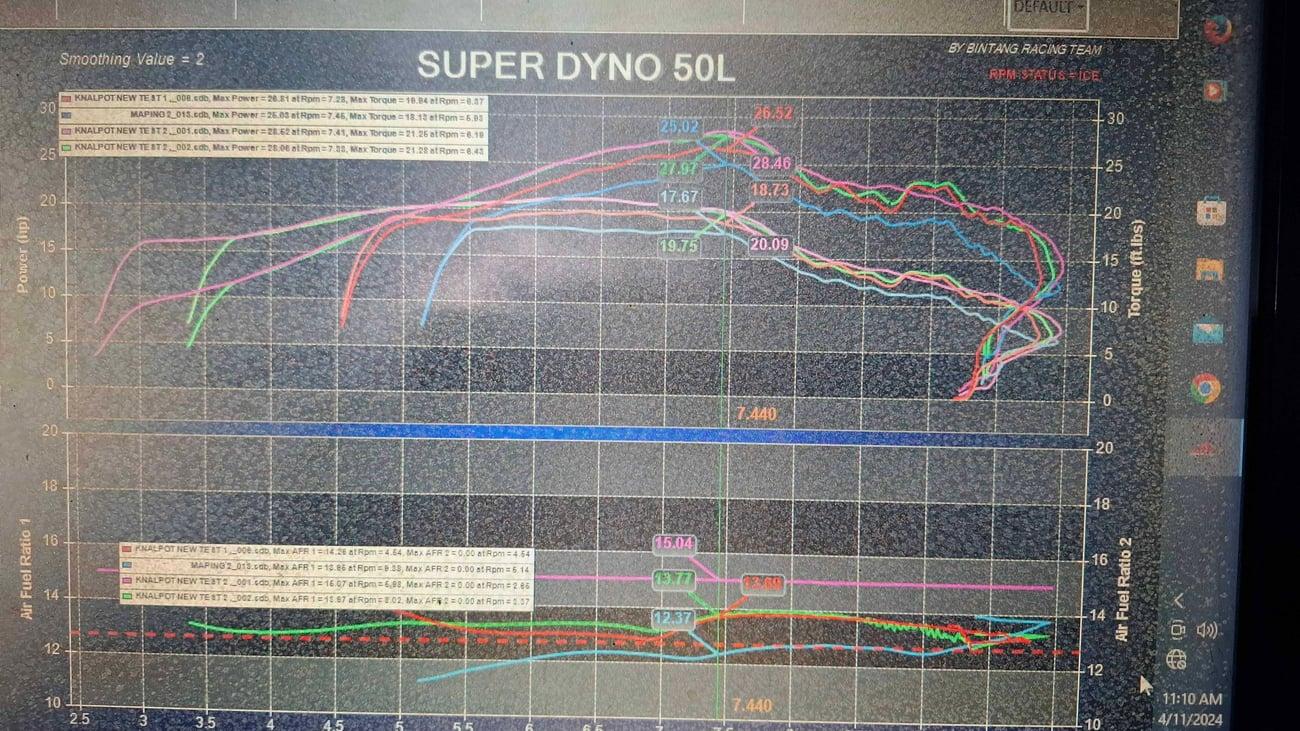
With correct air-fuel mixture (controlled with piggyback), removed subthrottle plate, free flowing full exhaust (with header) and open airbox (removed airbox cover and snorkel) KLX300 can produce about 28.5hp @ 7500rpm (pink line on the chart below).
Advanced ECU Tuning
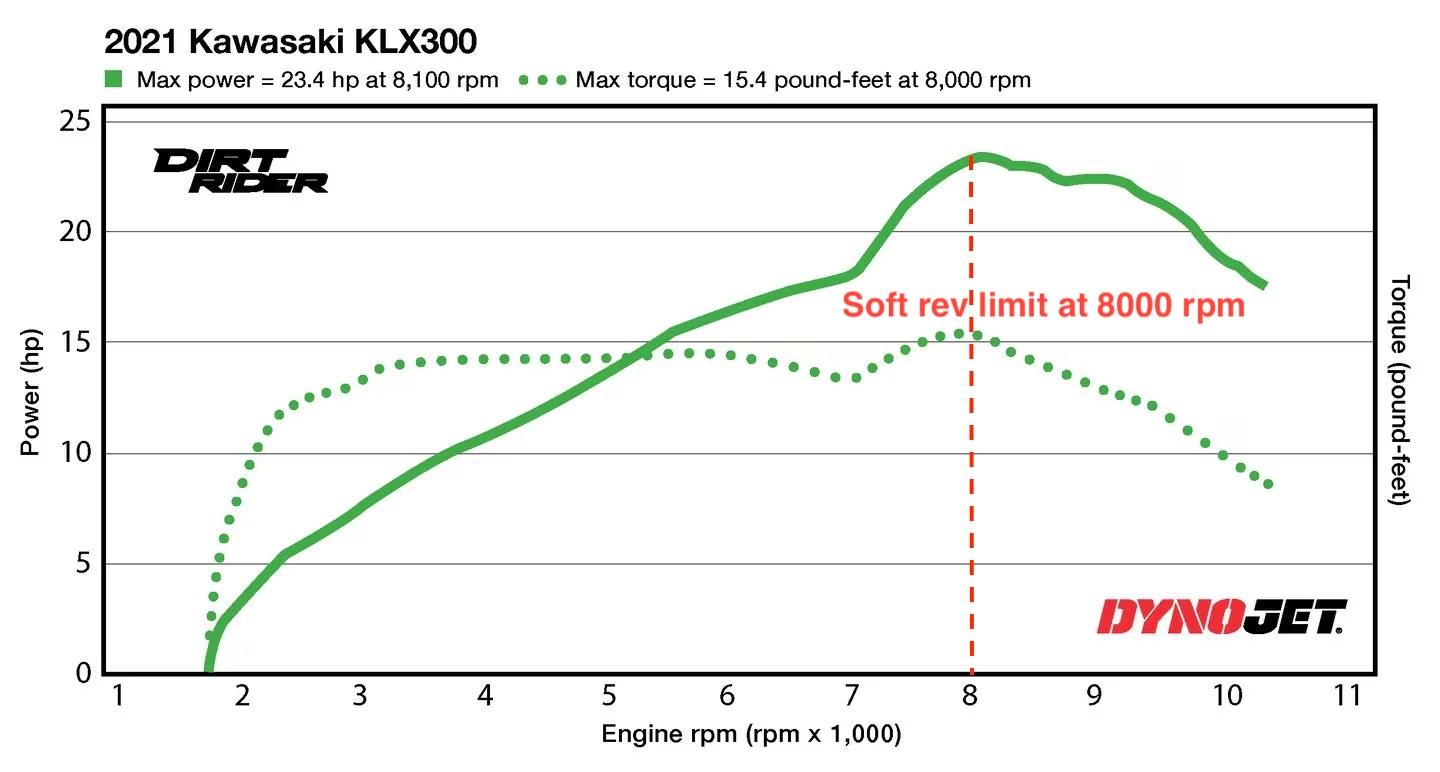
While fuel tuning is essential, it's not sufficient for really high performance KLX. As we discussed in ECU Limitations, Kawasaki put a "soft rev limiter" into the ECU which limits top end power.
We are aware of 3 ways to mitigate the soft rev limiter:
Unrestricted JDM ECU
Different countries impose different emission regulations. If we investigate the KLX250 Service Manual we will discover that on most markets:
- Bike produces 22hp@7500 rpm
- Ignition is BTDC 10° @1300 rpm to ~ BTDC 34° @11000 rpm
There are however 2 exceptions: Indonesia and Japan. In these countries the service manual states:
- Bike produces 24hp@9000 rpm
- Ignition is BTDC 10° @1300 rpm to ~ BTDC 39° @11000 rpm
Things are even more complicated. On fresh (2016+?) Indonesian motorcycles the ECU also has restricted ignition (tested on our own KLX250 2022).
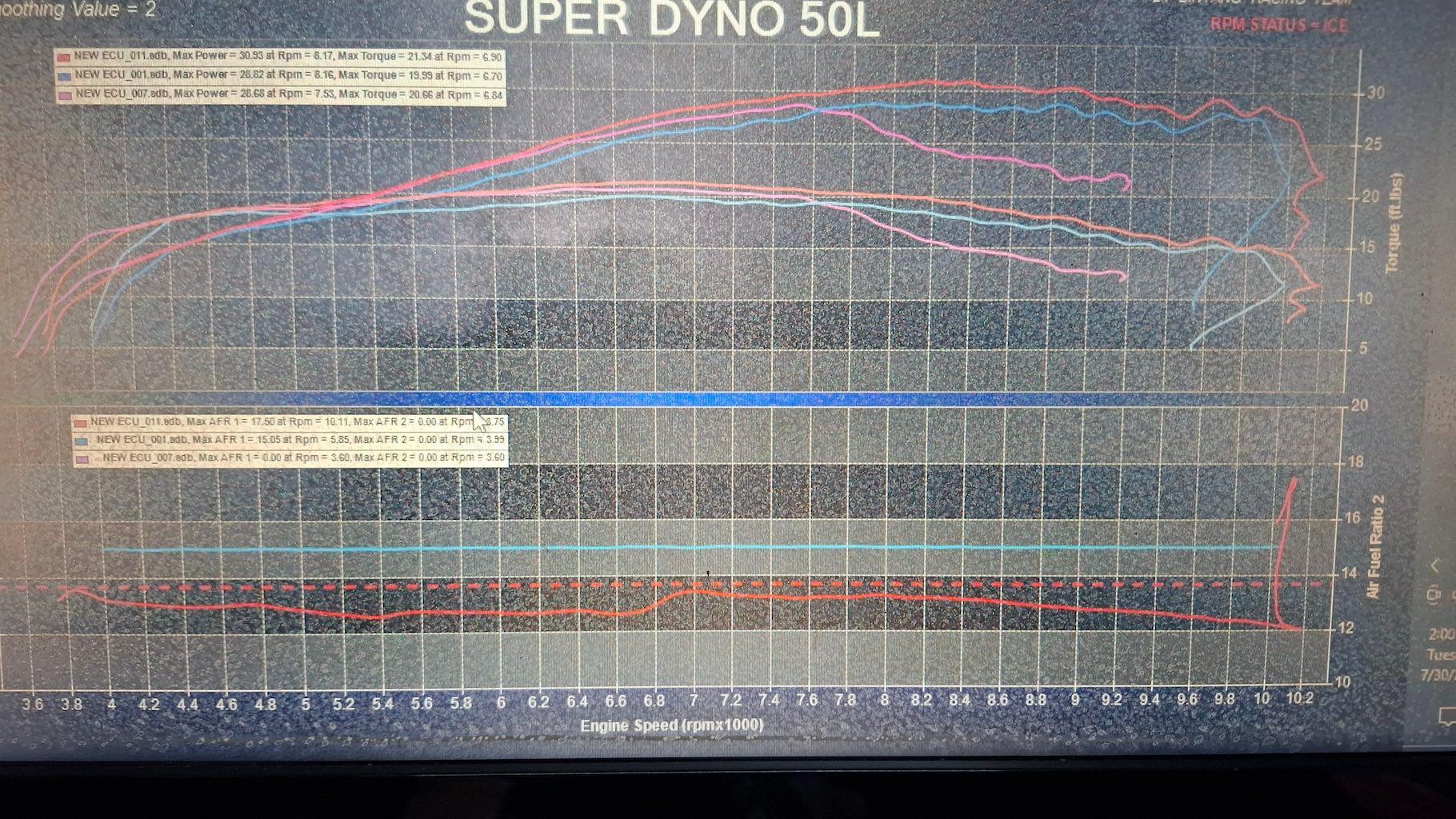
We've been able to purchase several unrestricted Japanese & Indonesian ECUs and test on the dyno. Results are impressive - 30.93hp@8200rpm (open airbox + full exhaust + removed subthrottle plate) and stable overrev power up to 10000rpm.
Compare to the pink line which is standard KLX250 ECU (same mods - open airbox + full exhaust + removed subthrottle plate):
Discontinued (2026). The JDM ECU is no longer available — the supply of used Japanese-market ECUs has dried up, and it won't be restocked. The successor is TuneFI: its TPS spoof recovers the ignition advance above 8000 RPM (the same top-end this ECU unlocked), and it adds the fuel control a fixed factory map never had. Full story.
ECU Reflash
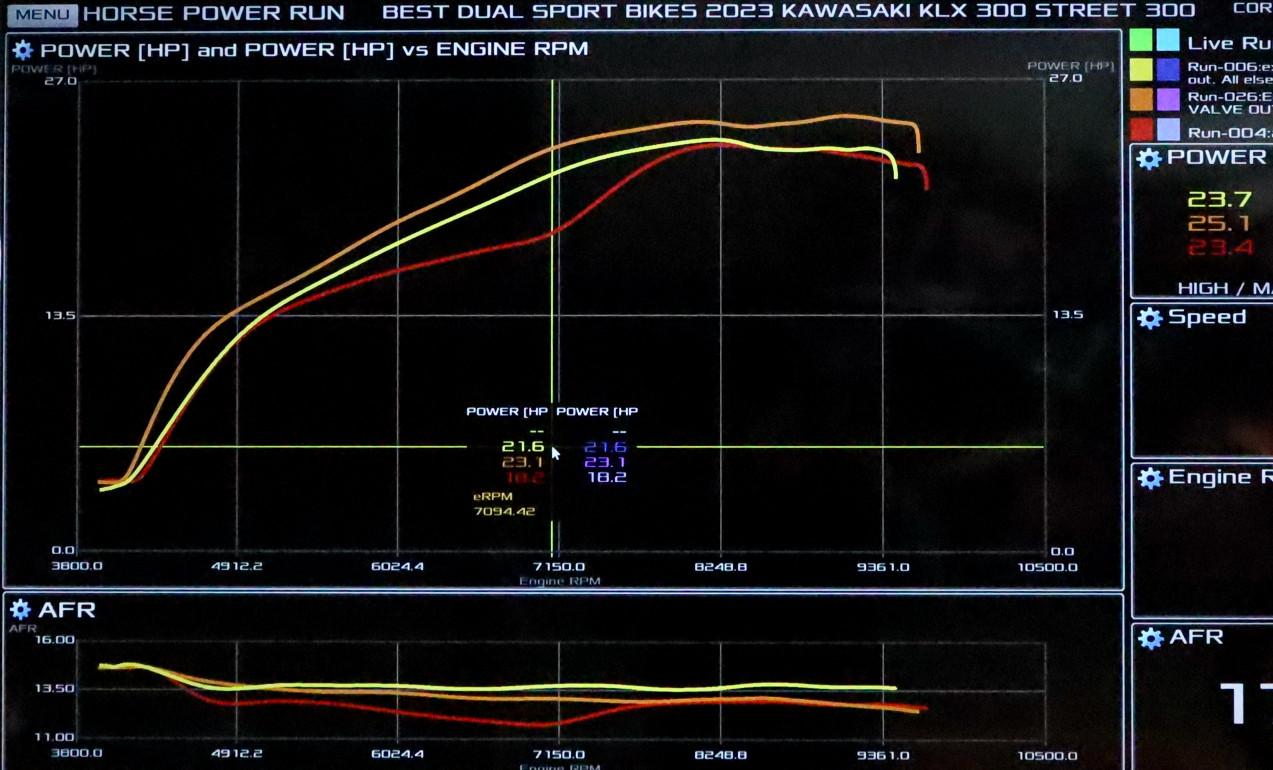
Best Dual Sport Bikes (BDSB) offers an ECU reflash for the KLX300 at $349. Their dyno claims ~10% across the range, peaking around 25 hp — but that number is paired with a modified exhaust and a drilled airbox, and most of it comes from the bolt-ons, not the flash. Look at the chart below — it's BDSB's own run (same dyno, same bike, same day): the biggest jump is pulling the subthrottle plate (red → yellow), and that's before the reflash is even in the picture. On ignition the reflash goes the wrong way too, removing advance instead of restoring the timing the stock ECU pulls at full throttle (the power cliff). For the full comparison — and why we don't recommend it — see the fuel controller comparison.
- Red - factory stock KLX300 with secondary throttle ("subthrottle") plate in place
- Yellow - factory stock KLX300 with secondary throttle ("subthrottle") out
- Orange - ECU reflash + modified exhaust + drilled airbox
Skepticism Note: We are skeptical about the "top end" power in the BDSB dyno charts as even the stock motorcycle (yellow line) doesn't show the same power loss at 8000 rpm soft rev limiter as on other dyno charts. BDSB likely uses aggressive "smoothing" on the power curves. Compare to a number of other dyno charts below:
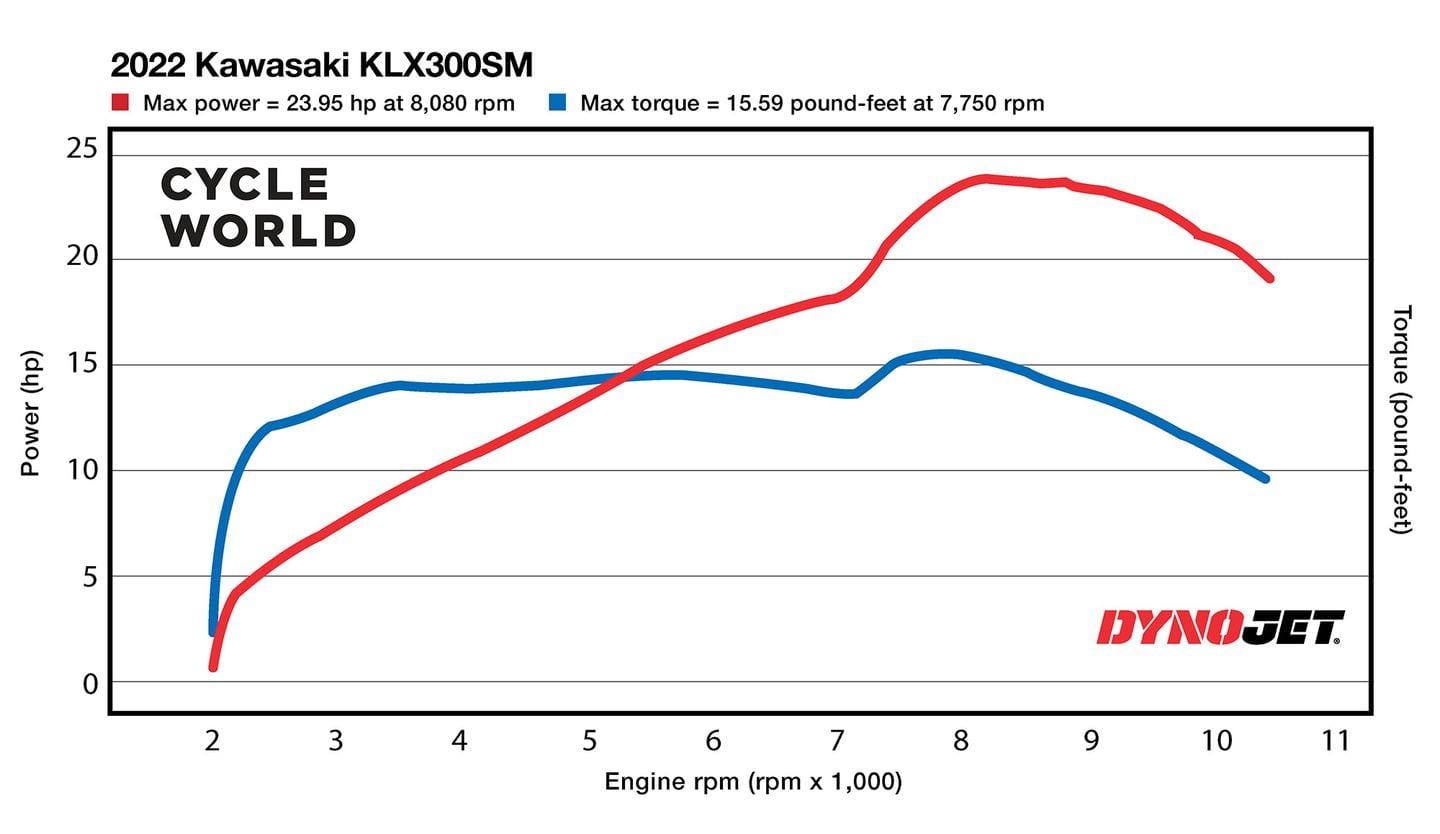
Aftermarket ECU
Thai company Apitech offers aftermarket ECU replacement for KLX250/KLX300. This is probably the most advanced solution as their standalone ECU provides complete engine management control including fuel management, ignition curves, throttle control, manifold pressure, etc.
The downsides:
- The software is not very intuitive and skilled engineers exist only in South East Asia
- According to Keng Engine (one of the "big bore" kit suppliers from Thailand), they stopped offering Apitech ECU to their customers due to poor reliability of their boards
Next Steps
- Engine Guide - Overview of all performance modifications
- Read about Intake modifications
- Check out Big Bore Kit options
- Browse Shop for the TuneFI fuel controller, snorkel, and injectors
Reference
The fuller picture on how the KLX meters fuel, for readers who want it.
The ECU receives signals from various sensors and determines when and how much fuel to inject for complete combustion in the cylinder. How does it know how much fuel is needed? The KLX250/KLX300 has an O2 sensor in the exhaust that measures oxygen levels. The ECU operates in two modes:
- Closed loop: Uses O2 sensor readings to adjust fuel delivery.
- Open loop: Ignores O2 sensor readings and relies on a pre-programmed fuel map.
Open Loop
Open loop is simpler. The ECU uses a fuel map (lookup table) based on sensor values to determine fuel injection amount. For example, it injects 1g of gasoline when:
- Air temperature is 20 degrees
- Air pressure is 101 kPa
- RPM is 4000
- Manifold pressure is 50 kPa
- Throttle position is 50% open
Open loop operation is limited and less efficient than closed loop, as it can't adapt to varying conditions. It's primarily used at wide-open throttle (WOT) and idle.
Closed Loop
In closed loop, the ECU combines sensor readings (including the O2 sensor) with the fuel map to make real-time adjustments. It can increase or decrease fuel delivery by up to 20–30% based on the O2 sensor's feedback.
Ideally, the ECU would always operate in closed loop, eliminating the need for additional tuning. However, there are limitations:
- The O2 sensor needs time to warm up.
- The engine must be in a stable operating condition.
- WOT conditions use a dedicated fuel map, bypassing the O2 sensor.
- Sensor failures require fallback options.
Technical Terms
| Term | Description |
|---|---|
| Closed loop | An operating mode where the ECU uses the O2 sensor signal to adjust the air-fuel mixture for optimal combustion. |
| Open loop | An operating mode where the ECU relies on a pre-programmed fuel map, without using the O2 sensor signal. |
| Air-fuel mixture | The ratio of air to fuel in the combustion chamber. Stoichiometric (ideal for complete combustion) is ~14.7:1. Lean mixtures have less fuel; rich mixtures have more. |
| O2 sensor | An exhaust sensor that measures oxygen content. The ECU uses it to determine whether the mixture is lean or rich. |
| Detonation | Uncontrolled combustion (knocking/pinging) from the mixture igniting prematurely under heat or pressure. Can damage pistons, rings, and valves. |
| ECU | Electronic Control Unit — the engine's computer, controlling fuel injection, ignition timing, and emissions. |
| Resistor | An electrical component that resists current flow. In the "O2 delete" mod, a resistor fakes the O2 sensor signal but can't replicate a real sensor's dynamic output. |