Intake and exhaust mods lean out the KLX. The stock ECU compensates in closed loop via the O2 sensor, but open loop (high load and wide-open throttle) runs a fixed fuel map that wasn't designed for modified bikes.
For the theory behind this — closed loop vs open loop, why the O2 delete mod is a bad idea — read the ECU Tuning guide. This article focuses on the hardware options for fixing fuel delivery.
The KLX250/300 is our worked example throughout — it's this site's focus — but the same logic holds for any EFI bike. The EJK and PCFC are sold for dozens of models, and TuneFI's design isn't KLX-specific either. The KLX is just where we started.
What You're Solving For
Four things matter when choosing a fuel management approach:
- Does it add fuel where needed? The basic requirement — can it compensate for increased airflow from intake/exhaust mods.
- Can you see what the engine is doing? Data logging (AFR, RPM, TPS) tells you if the tune is right. Without data, you're guessing.
- Is it adjustable? Static maps work for one setup. If you change anything later, you need to re-tune.
- Does it survive a throttle snap? The split-second you whack the throttle open breaks controllers that read the injector signal — they over-fuel right when you ask for power. (The deep dive: Why EFI Motorcycles Bog on Throttle Snaps.)
Most options solve #1. A few solve #3. Almost none solve #2 or #4 — and #4 is the one you feel as a flat spot. Below, the options run roughly in that order — from tune-by-feel controllers, through fixed and reflashed maps, to the one approach that measures the engine and builds the map from data.
270cc Injector Swap
Not a controller, but worth mentioning as the simplest option. The stock KLX250 injector flows 220cc/min. A 270cc injector (part 15710-21H00) flows ~23% more fuel across the entire RPM range. About $35 if you get a genuine one.
Works as cheap, no-controller insurance for a bike you've opened up — intake, exhaust, or a big-bore kit — where the real danger is a lean open-loop map. The 23% lands everywhere, but in closed loop the ECU trims most of it back via the O2 sensor, so the excess mainly shows up at WOT (open loop), where rich is safe and lean isn't. No adjustability, and +23% sits near the top of the ECU's ~20–30% closed-loop trim range, so idle and cruise can run slightly rich.
We covered this in detail in the ECU Tuning guide.
Best for: Modified bikes on a budget — the poor man's way to be on the safe side, trading some over-fuel everywhere for a cheap, plug-in richening of the open-loop map. Overkill on a stock bike; a stock KLX doesn't need +23%.
How a piggyback controller wires in
Every piggyback controller (EJK, PCFC, TuneFI) sits between the ECU and the injector. The manufacturer designs it as one of two architectures — and that engineering choice, fixed in the hardware, decides everything the box can and can't do.
Series — cut the ECU's injector wire and let the controller re-drive the injector itself. Powerful: it can add and subtract fuel. The catch: the controller is now in the critical path. It dies, gets wet, or glitches, and the bike dies with it. The PCFC is wired this way.
Loading diagram…
Series — the controller re-drives the injector. Cut the ECU's wire, put the box in line. If the box dies, the bike dies.
Parallel — leave the ECU's wire connected and fire a second injector driver alongside it. The injector takes whichever pulse is longer, so the controller can only ever add fuel. But pull the box and the bike runs exactly as stock — it gets you home. The EJK and TuneFI are wired this way.
Loading diagram…
Parallel — the ECU wire stays uncut (thick blue). The controller reads the ECU's pulse off that wire and only adds fuel (dashed). Pull the box and it's a stock bike again.
That second property — call it the walk-home test — is the real trade-off. Parallel (EJK, TuneFI) buys you walk-home safety but can only ever add fuel — you can't lean the bike out. Series (PCFC) buys you full add-and-subtract control but puts the box in the critical path: if it dies, the bike dies with it. For de-restricting a KLX you almost always need to add fuel — an open airbox and aftermarket exhaust push more air through, so the danger is running lean, not rich — which is why add-only is rarely a real limitation. You'd only need to subtract fuel in edge cases like high-altitude running or reining in an oversized injector; for that, only the series PCFC, a reflash, or a replacement ECU can do it.
One thing neither architecture escapes: a one-pulse delay every injector-reading controller shares on throttle snaps. Only TuneFI has fixed it — full breakdown in Why EFI Motorcycles Bog on Throttle Snaps.
EJK (Electronic Jet Kit)
Plug-and-play piggyback controller — the cheapest, simplest option, and it shows. It intercepts the injector signal and adds fuel across three coarse zones, adjusted via three knobs (low/mid/high) you turn with a screwdriver while riding.
The core problem: the EJK has no throttle-position or manifold-pressure input. With no direct load signal, it can only work from the injector pulse — RPM, plus a load estimate derived from pulse width/duty cycle. That's a blunt proxy: duty cycle rises with RPM even at a fixed throttle (the cycle period shrinks), so it mixes engine speed with load instead of measuring either. The result is three coarse zones, not a fuel map.
It's add-only, with no AFR input, no data logging, no Bluetooth. You set it by feel and plug-color readings — and you have no way to verify the result.
Capabilities:
- Add fuel in three coarse zones (RPM + duty-cycle blended)
- Quick installation (plug-and-play connectors)
- No laptop or tools needed for adjustments
Limitations:
- No load input (no TPS/MAP) — keys off the injector signal, a blunt proxy for airflow
- Add-only (can't lean out over-rich areas)
- No AFR feedback — tune by feel or plug readings
- No data logging — can't verify the tune
- Three zones only — no fine-grained mapping
- No ECU sensor access
Best for: We wouldn't run one — it's 2000s-era tech whose only real virtue is plug-and-play simplicity. If blind richening is all you want, the 270cc injector swap does it cheaper. The EJK adds fuel with no load signal and no way to verify the result; everything above it actually reads the engine.
Power Commander Fuel Controller (PCFC)
Full piggyback fuel controller from Dynojet, and the one series-wired option here. It cuts the ECU's injector wire and re-drives the injector itself — which is exactly why it can add and subtract fuel per cell, unlike the parallel (add-only) EJK and TuneFI. The cost is the walk-home test: with the PCFC in the critical path, a failed or glitching box stops the bike. It maps fuel across a proper 3D grid (RPM × throttle position) — far finer than the EJK's three zones — and each cell can be dialed in independently.
Mapping happens in Dynojet's desktop software — Windows-only, awkward, and with no live AFR integration. So building a real map means one of two things: tape a laptop and a separate wideband display to the bike and tune while you ride (a genuine safety risk), or pay for dyno time — which usually only maps wide-open throttle, a regime you're in maybe 1% of the time. Dynojet used to host base maps for common setups; they've been pulled from the site, so you're starting from a blank table or a forum file of unknown provenance.
And the "precision" is mostly on paper. The PCFC can't filter the RPM signal, so injector-line noise corrupts the RPM it derives — and corrupt RPM means the wrong map cell gets the fuel. Its throttle-enrichment handling (what Dynojet calls the "accelerator pump") is a blunt fuel-on-throttle-change add with no real transient model, so on a snap it gets the enrichment badly wrong. It also shares the one-pulse-late delay of every injector-reading controller — but where a parallel box turns that into over-fuel, the series PCFC turns it into a stale, mistimed correction: a bog. A 3D map is only as good as the signals feeding it.
Capabilities:
- Full 3D fuel mapping (RPM × TPS)
- Add and subtract fuel per cell
- Autotune module available (separate purchase, adds wideband feedback)
- Widely supported by tuners
Limitations:
- Series-wired — in the critical path; a failed box stops the bike (no walk-home)
- No RPM signal filtering — injector noise corrupts the RPM that indexes the map
- Laptop required; software is Windows-only and awkward
- No live AFR integration — Autotune is a ~$250 add-on that logs AFR for later desktop analysis
- No factory base map for the KLX (Dynojet pulled them from the site)
- On-road tuning means rigging a laptop + separate wideband display, or a dyno session that only maps WOT
- No ECU sensor access
- Price: ~$350-400 for the controller alone
Best for: Riders who want true per-cell precision (add and subtract) and can stomach a Windows laptop, a clunky workflow, and either a dyno or a $250 Autotune module to get there. Still the industry standard for piggyback mapping — the capability is real, the user experience isn't.
BDSB ECU Reflash
Best Dual Sport Bikes (BDSB) offers an ECU reflash for the KLX300 at $349. You ship them your ECU, they reflash it, ship it back. Marketed as fixing fuel and ignition in one shot — but the data doesn't back the marketing.
The ignition claim is backwards. A performance reflash should restore the timing the stock ECU pulls at full throttle (the 6° retard above 8000 RPM — the power cliff). BDSB's reflash does the opposite: it removes ignition advance. That's the wrong direction for power, and it means the reflash does not fix the power cliff — it makes ignition worse than leaving the ECU alone.
Most of the "reflash" gains come from the bolt-ons — and BDSB's own chart proves it. It's one controlled run (same dyno, same bike, same day): red = stock with the subthrottle in, yellow = stock with it out, orange = reflash + exhaust + drilled airbox. The biggest jump is red → yellow — pulling the subthrottle plate — and it lands before the reflash is even in the picture. We're not going to set our dyno numbers against theirs; different dyno, different tires, not apples-to-apples. BDSB's own controlled chart is the evidence, and on it the flash is the smallest contributor to the number it's sold on. (We've been skeptical of BDSB's dyno smoothing too — details in the ECU Tuning guide.)
And a credibility flip that tracks a new product. For years BDSB advised riders to leave the O2 sensor in place — now they sell an O2-delete dongle. Pair that with a reflash that retards ignition the wrong way and gains that come from the bolt-ons, and the pattern is hard to ignore: the advice tends to point at whatever they're currently selling.
Capabilities:
- Modifies fuel and ignition maps (ignition in the wrong direction — see above)
- Ship-and-forget installation
- Works with the stock injector
Limitations:
- Removes ignition advance — does not fix the power cliff, makes ignition worse
- Most claimed power comes from the intake/exhaust mods, not the reflash
- Fixed map — no adjustability after flashing
- Need to ship your ECU (bike is down ~1-2 weeks)
- Map is tuned for a specific setup — changes require another reflash
- No data logging, sensor access, or way to verify AFR
- Dyno charts use aggressive smoothing (skepticism note)
Best for: Hard to recommend on the data. You're paying $349 plus bike downtime for a reflash that removes ignition advance and delivers less power than the bolt-ons you'd do anyway with a piggyback. If you actually want ignition fixed, TuneFI's TPS spoof adds advance; BDSB takes it away.
JDM ECU
Discontinued (2026). The supply of used Japanese-market ECUs has dried up and it won't be restocked. Its role is now TuneFI's: the TPS spoof recovers the same ignition timing, with fuel control added. Full story on the JDM ECU page.
Factory Kawasaki ECU from the Japanese domestic market. Plug-and-play replacement with a different fuel and ignition calibration. The JDM map has 5° more ignition advance above 8000 RPM compared to the US KLX300 ECU.
On our dyno: 30.93 HP @ 8200 RPM with open airbox, full exhaust, and subthrottle removal. Stable power to 10,000 RPM — the US ECU falls off above 8,000. Full details in the ECU Tuning guide.
Capabilities:
- Factory Kawasaki hardware — proven reliability
- Addresses ignition retard at high RPM
- Plug-and-play — no wiring, no laptop
- Retains all stock ECU functions (O2 closed loop, idle control, etc.)
Limitations:
- Fixed factory map — no adjustability
- Doesn't address fueling for modified intake/exhaust (still need a piggyback or injector swap)
- Discontinued (2026) — no restock; successor is TuneFI
- Same fuel map regardless of your specific setup
Best for: Riders who wanted to fix the top-end power cliff and keep the factory ECU, usually combined with a piggyback controller or injector swap for fuel compensation. No longer available.
TuneFI
Full piggyback fuel controller with integrated data logging and ECU sensor access. The architecture works on any EFI single or twin — KLX250/300 is just where community testing is running today.
TuneFI is parallel-wired — add-only, walk-home safe (unlike the series-wired PCFC, which can subtract but stops the bike if it dies). It derives RPM and engine load straight from the injector pulse and layers a wideband O2 sensor (Spartan 3 via UART) on top for real-time AFR. 100Hz sampling across all channels — ~1,000 data points a second (roughly 1.2 million from a 20-minute ride).
The logged data feeds a fuel map generation tool. Ride the bike, export the log, get a corrected fuel map based on your AFR targets (14.7:1 at cruise, 12.5:1 at WOT). No cell-by-cell manual editing.
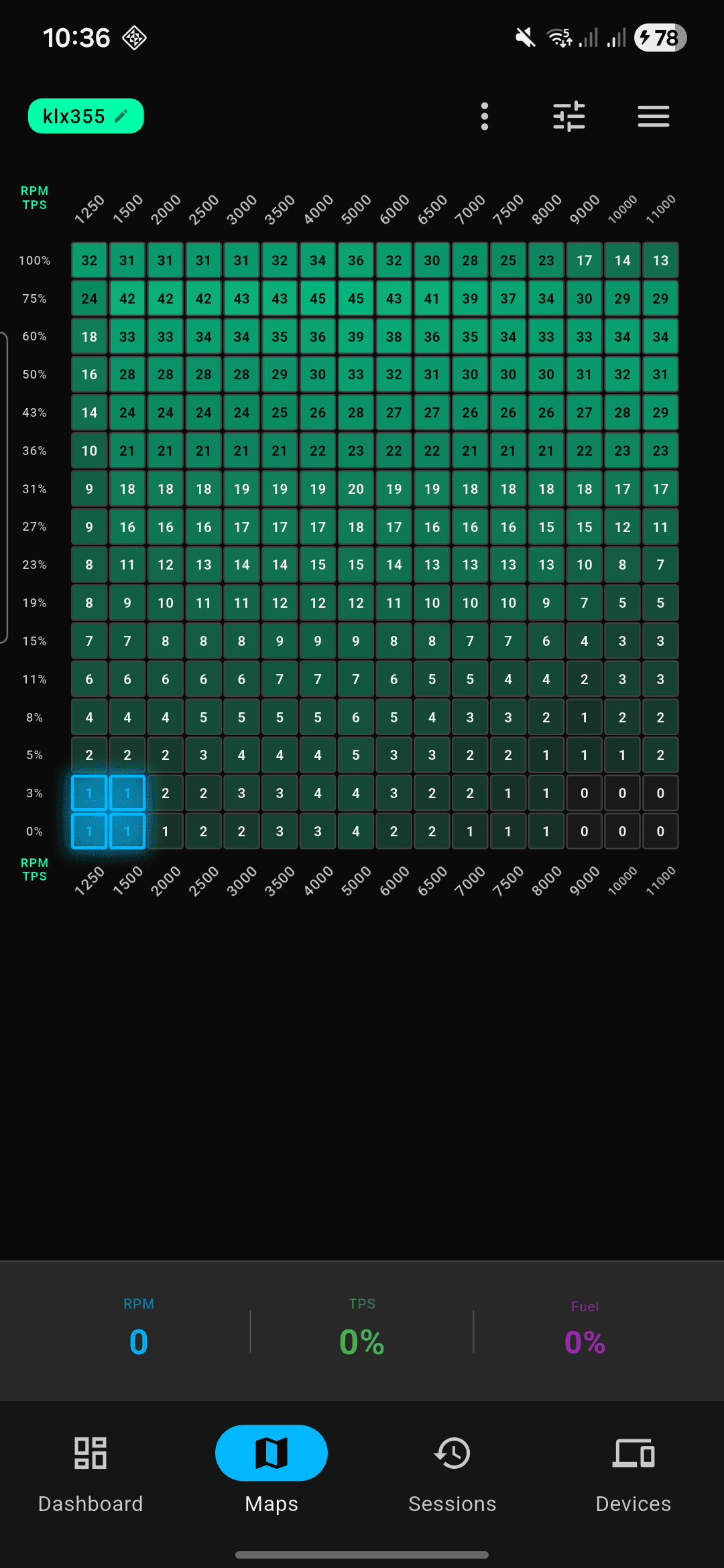
It also reads factory ECU data through the diagnostic port via K-line protocol — RPM, throttle position, coolant temp, intake air temp, battery voltage, vehicle speed, manifold pressure, and FI codes. All on your phone.
The one thing no other piggyback here does. Every injector-reading controller — EJK, PCFC, older TuneFI firmware — has the same blind spot the instant you snap the throttle: it has to measure one pulse and react on the next, right when the ECU is already firing its throttle-enrichment shots. In an add-only (parallel) box that means over-fuel — the injector takes the longer pulse, so a 1 ms enrichment squirt gets stretched toward 10. We traced it from a rider's log, then fixed it in firmware: a hardware timer adds fuel only at the end of each pulse (a small tail), so it can only extend — never over-fuel. No software in the timing path, so the pulse can't stick open or snap shut mid-stroke. Shipped over-the-air as v0.31.0; 99.4% of pulses now deliver the intended enrichment. Full breakdown: Why EFI Motorcycles Bog on Throttle Snaps.
The blind spot every legacy controller shares — a 1 ms enrichment shot stretched toward 10 ms.
There's one more trick — and no other piggyback here can touch it. The KLX300 ECU pulls ~6° of ignition timing at full throttle above 8000 RPM (the power cliff that costs ~2 HP) — but only at 100% throttle. At ~80% it stays fully advanced. So TuneFI clamps the throttle-position signal it feeds the ECU: real TPS below 8000 RPM, capped at ~80% above it. The ECU never sees full throttle, stays in the advanced cell, and you get the timing back — no reflash, no JDM ECU. Status: the TPS-spoof circuit is validated on V3 hardware and tested on the bike — it recovers the factory timing retard above 8000 RPM and ships with the Full tier.
Capabilities:
- 3D fuel mapping (RPM × TPS) — add-only (parallel)
- 100Hz data logging: TPS, RPM, injector pulse width, AFR
- Wideband O2 integration (Spartan 3)
- Fuel map generation from ride data
- ECU sensor access via K-line diagnostic port
- Throttle-snap over-fuel fix — falling-edge tail, hardware-timed (unique)
- TPS spoof / ignition restore — recovers power-cliff timing, validated on V3 hardware (Full tier)
- Bluetooth phone app (Android)
- OTA firmware updates
- RISC-V real-time processor, automotive-grade injector driver
Limitations:
- First production batch ordered — initial units shipping, not yet widely in stock
- Android app only (iOS not confirmed)
- Requires wideband O2 sensor for AFR logging (separate purchase)
- Community testing is KLX250/300 only today (the hardware handles any EFI single or twin; other platforms are roadmap)
- No laptop software — phone app only (pro or con depending on preference)
Best for: Riders who want to see the data and tune from actual measurements rather than guesswork. The data-logging-first approach means you can verify your tune is correct, not just hope it is.
Community testing program is open — details on the TuneFI page.
Comparison
| EJK | PCFC | BDSB Reflash | JDM ECU | TuneFI | |
|---|---|---|---|---|---|
| Fuel control | Add only (3 zones) | Add + subtract, full 3D map | Fixed reflash | Fixed factory | Add only, full 3D map (auto) |
| AFR input | No | Optional (Autotune) | No | No | Integrated (Spartan 3) |
| Data logging | No | No (Autotune: yes) | No | No | 100Hz (TPS, RPM, AFR, pulse width) |
| ECU sensors | No | No | No | No | K-line (all sensors) |
| Adjustability | 3 knobs | Per-cell (laptop) | None (reflash) | None (fixed) | Auto-generated from data |
| Throttle-snap bog | Over-fuels | Bogs (crude AP) | Native (ECU) | Native (ECU) | Fixed (falling-edge) |
| Ignition timing | No | No | Removes advance | Yes (factory) | Yes (TPS spoof) |
| Phone app | No | No | No | No | Yes (Android) |
| Setup | Plug and play | Laptop + dyno/wideband | Ship ECU | Plug and play | Plug and play + phone |
| Price range | ~$200-250 | ~$350-400 | $349 | Discontinued | Community testing |
The JDM ECU was discontinued in 2026 — no restock. TuneFI's TPS spoof covers its ignition advantage, with fuel control added.
What We'd Run
For a KLX with intake and exhaust mods, the minimum is fuel compensation. The cheapest honest option is the 270cc injector swap — fixed richening, no controller, no guessing. (Skip the EJK: no load signal, tune by feel — 2000s tech.) Most riders only ever need to add fuel, so an add-only controller like TuneFI is rarely a real limitation — but if you genuinely need to pull fuel somewhere, the series-wired PCFC is the only piggyback here that can (at the cost of a failed box stopping the bike).
If you want precision and are willing to use a laptop: PCFC. It's the industry standard for a reason, and the Autotune module adds AFR feedback.
The JDM ECU solved the ignition timing problem (the power cliff above 8000 RPM) but didn't fix fueling for modified bikes — most riders combined it with a piggyback controller. It's now discontinued; TuneFI's TPS spoof recovers the same timing with fuel control built in.
The BDSB reflash is sold as the single-installation fix for fuel and ignition — but it removes ignition advance, and our dyno data shows most of its claimed gains come from the bolt-ons you'd do anyway. On the numbers, full bolt-ons plus a piggyback beat it for less hassle.
TuneFI is the only option that logs AFR alongside engine operating conditions, generates fuel maps from the data, and doesn't over-fuel when you snap the throttle. If you want to know what your engine is actually doing — not just add fuel and hope — that's the differentiator.
Related
- ECU Tuning Guide — Fuel injection theory, closed/open loop, injector swaps
- Why EFI Motorcycles Bog on Throttle Snaps — The blind spot every injector-reading piggyback shares on a throttle snap, and the fix
- KLX300 Ignition Timing Analysis — The power cliff at 8000 RPM decoded from the ECU binary
- TuneFI — Hardware, software, and community testing program
- Engine Guide — Overview of all KLX performance modifications